
Most Catholic families start Advent with a plan. Candles, a calendar, a daily reading, a saint for each day, straw in the manger. By the second week the candles have gone out, the calendar is three days behind, and everyone feels quietly guilty about it.
This is a guide to doing less, and doing it properly. The dates for 2026, the traditions that survive contact with a three year old, and the four feast days hiding inside the season that most families walk straight past.
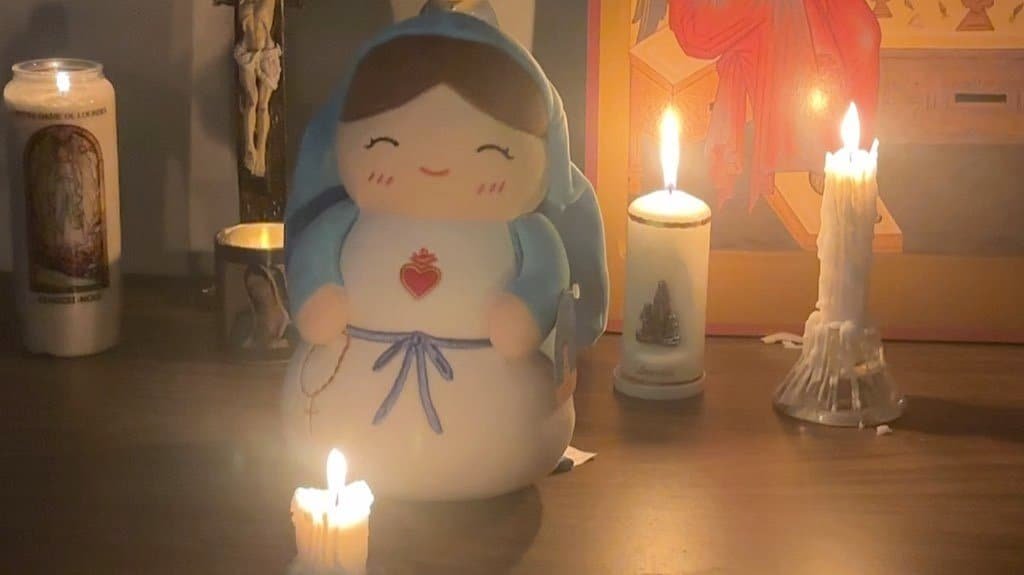
What Advent is, in words a child can hold
Advent is waiting.
That is the whole thing. Four weeks of getting ready for somebody to arrive. A child who has ever waited for a birthday, or for a grandparent’s car to pull into the driveway, already understands Advent. They just do not know the word yet.
The Church spends these four weeks waiting the way Mary waited, which is the part most explanations leave out. She spent nine months carrying a child nobody else could see yet. Advent is the Church doing a short version of that same wait, every year, on purpose.
If your child asks what we are waiting for, the honest answer is better than the simple one. We are waiting for Jesus to be born, and we are waiting for him to come again. Children handle the second half of that better than adults expect.
Advent 2026 dates
| First Sunday of Advent | Sunday 29 November |
| Second Sunday of Advent | Sunday 6 December |
| Third Sunday of Advent, Gaudete | Sunday 13 December |
| Fourth Sunday of Advent | Sunday 20 December |
| Christmas Day | Friday 25 December |
Advent always begins on the fourth Sunday before Christmas, which is why the date moves each year. In 2026 it starts on 29 November, two days after Black Friday, which tells you something about the season you are trying to protect.
The Advent wreath, and how the candles actually work
An Advent wreath is a ring of evergreen laid flat on a table or a shelf, with four candles standing in it. You can buy one or make one. A circle of greenery with four candles in jars is a perfectly good version.
Three of the candles are purple and one is rose, which is a soft pink.
Here is the part that confuses people, including plenty of adults who grew up with one. You do not light a new candle every day. That is the calendar. With the wreath you add one candle each Sunday, then light that same set every evening for the week that follows.
- Week one, from Sunday 29 November: one purple
- Week two, from Sunday 6 December: two purple
- Week three, from Sunday 13 December: two purple and the rose
- Week four, from Sunday 20 December: all four
By the last nights before Christmas the whole ring is burning and the room is noticeably brighter than it was in November. That brightening is the entire point, and children notice it without being told.
The rose candle on the third Sunday is for Gaudete, which means rejoice. The color lifts because the waiting is nearly over.
Three practical things nobody mentions. Put it somewhere a small child cannot reach, because the middle of the dinner table is the traditional spot and the worst one. One prayer is enough, so light the candle, say grace, blow it out after dinner. And let the child light it once they are old enough, because nothing in Advent will matter more to a six year old than being the one who holds the match.
Advent is Mary’s season
This is the part that gets lost under the calendars and the crafts.
Everything Advent is about happened to a young woman who said yes and then waited. The angel came to Mary. Mary carried him. Mary traveled while heavily pregnant because a census said so. The entire season is a pregnancy, told from the outside.
That is why Our Lady appears twice on the calendar in the middle of Advent, and why both of those feasts matter more than their placement suggests.
It also means that if you want one image to give a small child for the whole four weeks, Mary carrying Jesus is the right one. Not a stable. Not a star. A mother waiting for her baby, which is something even a very young child already has a feeling about.
The Joyful Mysteries are the Advent story
Most parents have prayed the Joyful Mysteries a hundred times without noticing that the first three of them are exactly what December is.
The Annunciation. The angel comes to Mary and she says yes. This is where Advent really starts, not on the first Sunday but here, with a young woman agreeing to something enormous before she can possibly know what it will cost her.
The Visitation. Mary, newly pregnant, travels to her cousin Elizabeth. John leaps in Elizabeth’s womb. It is the first time anybody other than Mary meets Jesus, and he is not born yet. If you want a single scene that captures what waiting alongside somebody feels like, it is two pregnant women in a doorway, both carrying something they do not fully understand.
The Nativity. The waiting ends.
Pray those three in December and you are not praying alongside the season, you are praying the season itself. The calendar and the Rosary are telling the same story, in the same order, at the same time of year. Most people never notice because the Rosary feels like something separate from the liturgical calendar, a devotion you do rather than a season you are in. In Advent they line up exactly.
There is something else worth saying here. Children struggle with much of the Rosary, because a good deal of it is adult sorrow and heavenly glory, and neither of those is a four year old’s world. The Joyful Mysteries are not like that. They are about a mother, a cousin, a journey and a baby. A child can picture every one of them without being told how to feel about it. And December is when the whole Church is looking at those scenes anyway, so a family praying them is simply joining in with what is already happening.
A rosary is the greater thing in any house, in any season. In Advent it also happens to be the most seasonal thing in the house.
An Advent calendar that isn’t chocolate
Chocolate calendars are fine and nobody needs to feel bad about one. But if you want the counting to carry something, the usual alternatives are these.
- One nativity figure a day. The set goes out empty and fills across December. Shepherds arrive late. The kings do not arrive until January, which is a lesson in itself.
- A saint a day. One paragraph about one saint. Ten seconds for a three year old, two minutes for a seven year old.
- A kind act a day. Written on a slip and drawn at breakfast. This is the version that works best with more than one child, because they can be given different ones.
- Something to color. Our coloring pages are free to download, so a printed stack by the kitchen table costs you nothing and buys you twenty quiet minutes on the afternoons when nobody can go outside.
Straw in the manger
If you only do one thing from this entire page, do this one.
Put the crib out at the start of Advent with the manger empty. Keep a bowl of straw, or shredded paper, or cut yellow yarn beside it. Every time a child does something kind, they put one piece in. Nobody counts it, nobody scores it, and a parent can quietly add a handful when it is looking thin.
On Christmas morning the baby is there, lying on four weeks of everyone’s good behavior.
It works because it is physical, because it builds up where a child can see it, and because it makes kindness feel like preparation rather than instruction. It costs nothing. It is the tradition most families who try it are still doing ten years later.
The four feasts inside Advent
Advent is not four blank weeks. There are four feast days inside it, and each one gives you a single thing to do.
St Nicholas, Sunday 6 December. Shoes by the door the night before, something small in them by morning. Chocolate coins, a clementine, a small toy. This is the real St Nicholas, a bishop who gave in secret, and it is worth telling children that the Santa they know grew out of a man who actually existed and actually did this.
The Immaculate Conception, Tuesday 8 December. A Holy Day of Obligation, so Mass. The feast is about Mary being preserved from sin from the first moment of her existence, which is a hard idea for a child and does not need explaining in full. “God got her ready to be his mother from the very beginning” will carry a seven year old a long way.
Our Lady of Guadalupe, Saturday 12 December. Our Lady appeared to Juan Diego, an ordinary man, and left her image on his cloak, where it still is. For Hispanic Catholic families this is one of the biggest days of the year. For everybody else it is the best story in December after the Nativity itself, and children love it because there are roses in winter and a picture nobody painted.
St Lucy, Sunday 13 December. Lucy means light, and her feast lands in the darkest part of the year. In 2026 it falls on Gaudete Sunday, so the rose candle and the saint of light arrive together. Sweet bread and candles, and an early bedtime because it is a Sunday.
What to expect, by age
Three to five. One tradition, repeated. The candle or the straw, not both. They will not remember the content. They will remember that something happened every evening in December that did not happen in November.
Six to nine. This is the best age for Advent. They can light candles, read a line, remember yesterday’s saint and ask about tomorrow’s. Give them a job and let them own it.
Ten and up. They have opinions now, and one of those opinions may be that this is for little kids. Let them help run it rather than receive it. An older child who is in charge of something stays involved. An older child who is told to sit down for it does not.
Where the plushie fits
Earlier on this page we said the Joyful Mysteries are the Advent story, and that the Rosary and the calendar are telling it at the same time, in the same order. There is a practical problem with that in a house with small children. A three year old cannot really pray a decade, and the ones who try struggle through it. They can sit near you while you pray, and they will, but the words go past them.
What they can do is hold something.
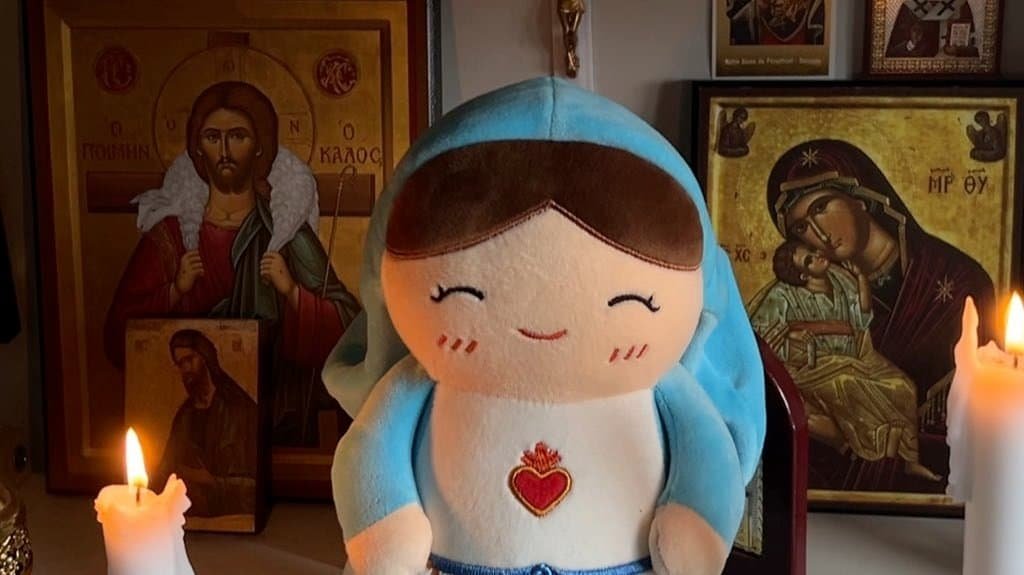
A Virgin Mary plushie gives a small child the thing the whole family is praying about, in a form they can carry. You pray the Visitation while your child sits beside you talking to Mary and playing with her. That is not a substitute for the Rosary. It is what lets a small child be genuinely present for it instead of parked beside it.
The small gold rosary on her dress does more work than we expected. It is almost always the first thing a child asks about, usually in the first week, and the question answers itself. That is what we are doing when we pray.
If you are buying one, there are two good moments. Give it on the first Sunday of Advent and the child carries Mary through all four weeks of the waiting, which is the version that fits the season. Or give it at Christmas, as the gift that stays long after the morning is over.
Doing less, properly
Pick one thing. Do it every day, or every Sunday, without fail. Add a second thing only if the first is still running by the second week of December.
A family that lit one candle every Sunday and did nothing else had a real Advent. A family that bought the wreath, the calendar, the Jesse tree and the saint cards, and abandoned all four by 8 December, had two stressful weeks and a vague sense of failure.
The waiting is the tradition. Everything else is a way of noticing it.
Common questions
When does Advent start in 2026?
Sunday 29 November. It always begins on the fourth Sunday before Christmas, so the date changes every year.
What do the Advent candle colors mean?
Three purple for penance and preparation, one rose for Gaudete Sunday in the third week, when the mood lifts because Christmas is close.
Do you light one candle a day?
No. You add one candle each Sunday, then light that set every evening during the week that follows. One candle in week one, four by the last week. Daily opening is the Advent calendar, which is a different thing.
Is Advent just a Christmas countdown?
No. A countdown marks time until a party. Advent is preparation for an arrival, and the Church treats it as a season in its own right, with its own color, its own readings and its own feast days.
How do I explain Advent to a three year old?
“We are waiting for Jesus to be born.” Then light a candle. That is enough for a three year old and more than most adults manage.
Do I have to do all four weeks?
No. Start late if you need to. A family that begins on 8 December has still kept Advent.
Can we put the Christmas tree up during Advent?
Plenty of Catholic families do, and plenty wait until Gaudete Sunday or Christmas Eve. There is no rule. If you want the season to feel distinct from Christmas, leaving something until the end helps.
Before the season starts
Whatever you are planning, get it ready in November. Advent begins on 29 November this year and the first Sunday arrives faster than anyone expects.
Order by December 14 to receive it before Christmas.
Every order helps a child in need.
More from our blog: Catholic Christmas gifts for children · All Saints Day ideas for Catholic kids · Virgin Mary quotes: words she actually said