
Every Catholic parent has bought the gift that gets put away. The holy card that ends up unused in a book. The statue on a shelf that just sits there. The rosary their child doesn’t really pray. The beautiful thing that was given with love and never quite got used.
None of it was a bad gift. It was given ahead of the child.
That is the whole problem, and it is worth saying plainly before any gift guide starts. A statue is for someone who already prays. A holy card is for someone who already has a favorite saint. Given to a child who has neither yet, it becomes an object they are told to respect rather than one they use. Respect at four years old looks like leaving it alone.
This is a guide to Catholic Christmas gifts children actually pick up, sorted by age and by who you are buying for.
What makes a devotional gift last
Four questions sort the gifts that get used from the gifts that get shelved.
- Can the child hold it? Not handle carefully. Hold. Carry upstairs, take in the car, drop.
- Does it survive being loved badly? A child who loves something will wash it, lose it under a bed for two weeks, take it somewhere it should not go. A gift that cannot take that is a gift for the parent.
- Is it theirs? A shared family object belongs to the house. A child needs something that belongs to them specifically, with their name on it in their own head.
- Does it point somewhere? The gift is not the end. It should raise a question the child asks you, which is how devotion actually starts in children. Not explanation first. Question first.
Most Catholic gifts for children fail on the first two. The ones that last are soft, washable, and small enough to carry. Our plushies are recommended for ages three and up, with an embroidered face rather than a printed one, so nothing wears off in the wash.
For a young child, three to five
This is the age the whole category is built for, and the age most Catholic gifts miss completely.
A three year old cannot pray a decade, cannot read a saint’s life, cannot be told who a statue represents and retain it. What they can do is attach to one object with total seriousness. Whatever is in their arms at that age gets a name, a personality, and a place in the car.
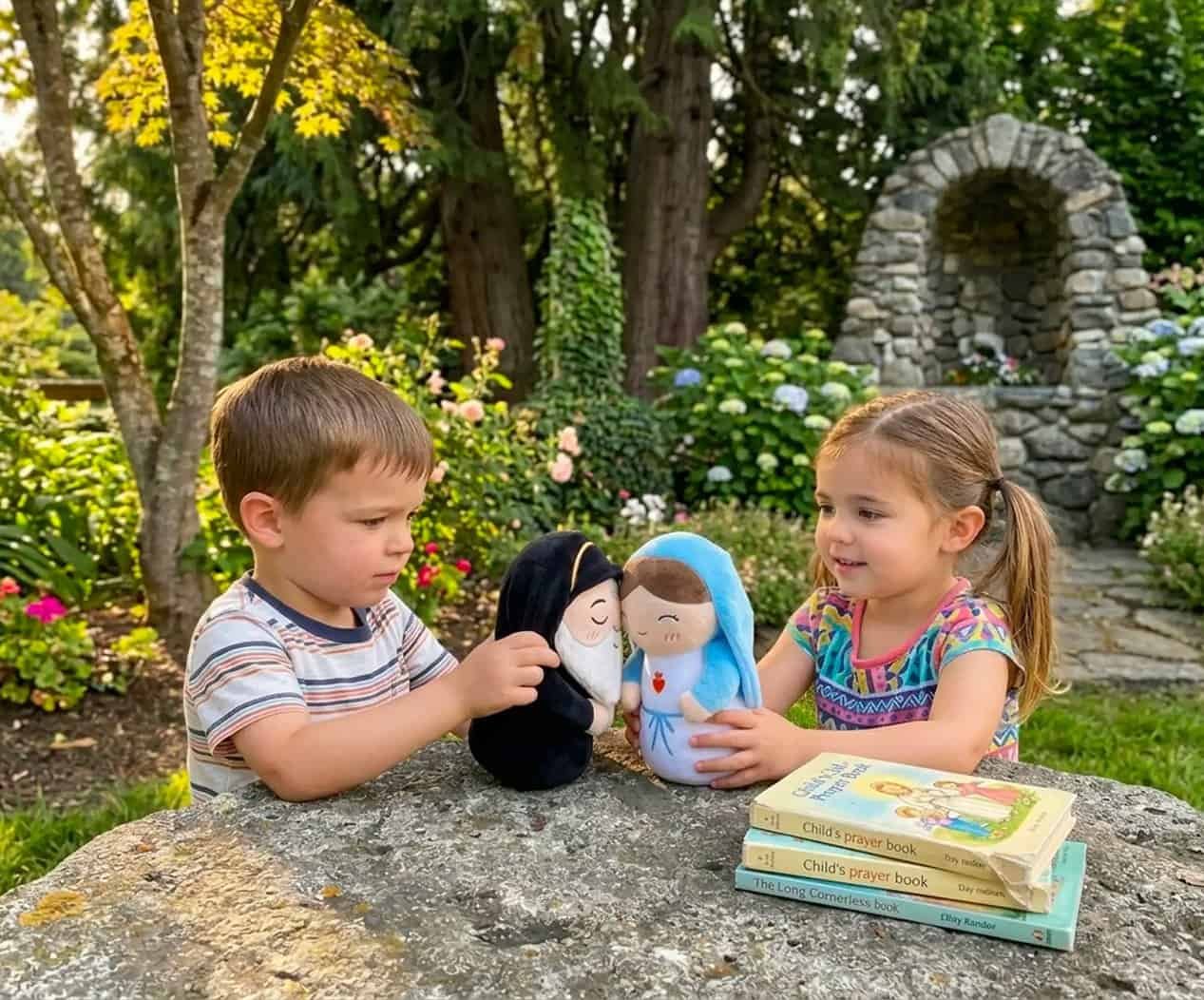
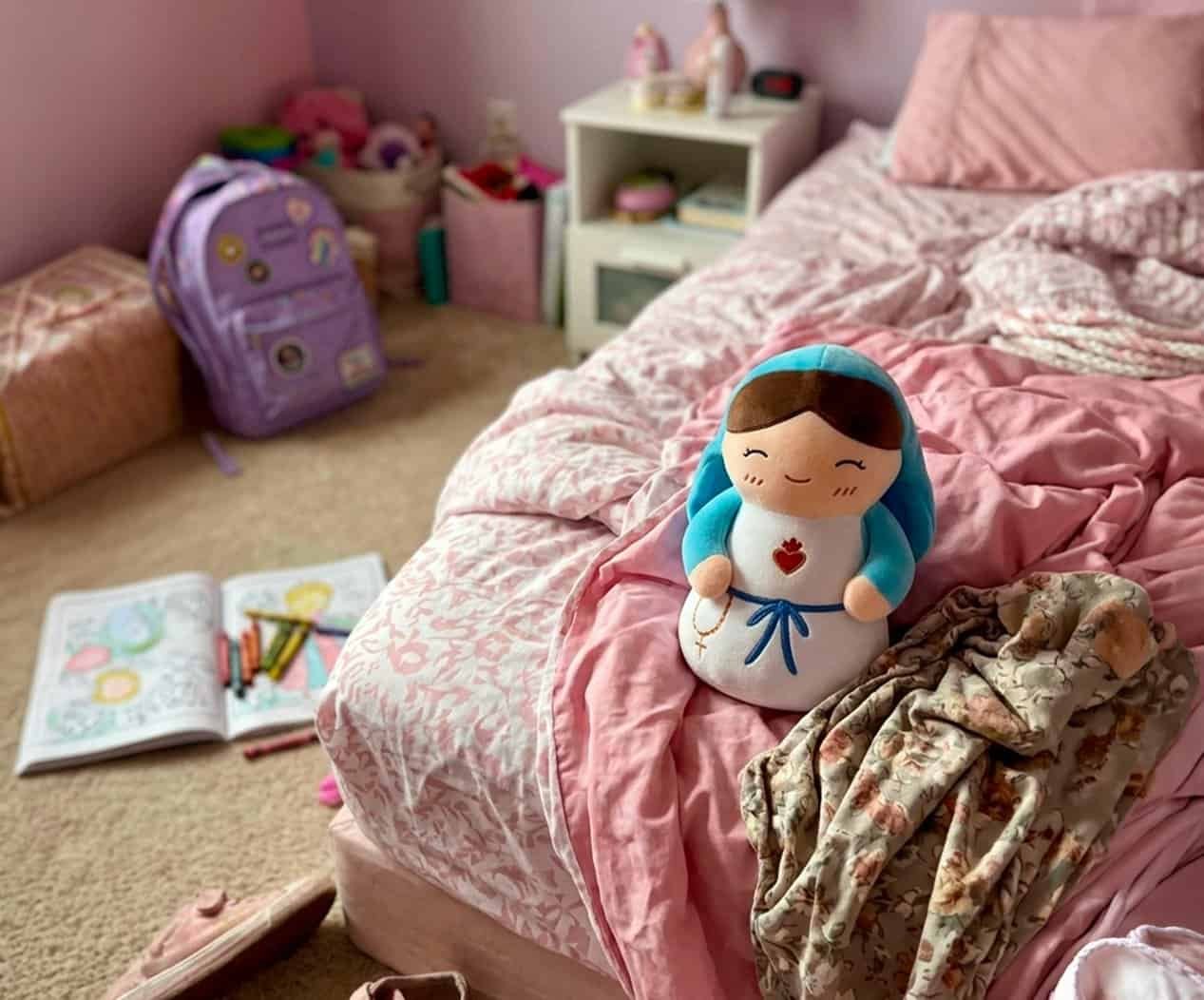
So give them the thing they will attach to, and let it be a saint rather than a cartoon. A Virgin Mary plushie wears a small gold rosary on her dress, which is usually the first thing a child this age asks about, and the asking is worth more than any amount of explaining.
One plushie is enough here. Do not buy a set and split it across years. A four year old with two does not love either twice as much.
For school age, six to nine
Children here start to want the story behind the object. They will ask what a saint did, and they will accept a real answer.
That is why the plushie works better at six than people expect. A three year old holds Mary because she is soft. A six year old keeps her because they decided to, and a child who has decided something about a saint at six tends to still mean it at ten. The toys that cycle out of a bedroom at this age are the ones nobody chose.
Give it to them and the question arrives on its own, usually within a day. Then tell them the real story, not the simplified one. At this age they can take it.
For older children, ten and up
A plushie still works at this age. Plenty of ten and twelve year olds keep the one they grew up with, and a new saint is still a real gift. What changes is that you can now add the things a younger child could not use yet. A proper rosary, because now they can actually pray it. A real book on a saint whose life has some edge to it. A medal they can wear under a shirt, which matters to a child who wants their faith to be theirs rather than their parents’.
A keychain (12+) clipped to a school bag works here too. It is the age where that quietly says something to the other children without anybody having to announce it.
One thing worth saying plainly, because it matters more than any product on this page. As children get closer to their teenage years, it means a great deal to them not to feel their faith is being pushed on them at every turn. Giving them a normal Christmas gift, the thing they actually asked for, is a kindness. It tells them you were listening to who they are rather than who you are raising them to be. A saint plushie or a keychain alongside that is wonderful. But if the saint gift is the only thing they ever open, year after year, it stops feeling like a present and starts feeling like a lesson.
So ask your child what they want, and give them that. Then add the saint if it fits.
For a godchild
Godparents have the hardest brief at Christmas. The gift should mean something, but nobody wants to be the one who gave another keepsake.
For a young godchild the plushie on its own is the right call. It reads as a proper gift rather than a token, it survives being actually used, and it carries the faith without requiring the child to already have one.
If you do not know the family’s devotional life well, soft and usable is the safe end of the scale. Nobody has ever been offended by a plush Our Lady. Plenty of parents have quietly rehomed a statue.
For two children
Buy one saint for a house with two children and you have created a problem, not solved one.
Two plushies together is the fix. One each, no negotiation on Christmas morning, and it costs less than buying them separately. That matters when you are buying for a family rather than for a child.
Something for Christmas afternoon
The hour after the presents are open is the hard one. Everything is out of its box and nobody knows what to do next.
Our Saint Plushie coloring pages are free to download, so there is no reason not to have them printed and waiting. They cost you nothing but the paper, and they fill the afternoon when the morning is already over.
The rosary matters more than the plushie
Let us be plain about that. A rosary is the greater thing. It is a prayer of the Church, it has carried saints through war and grief, and no soft toy is a substitute for it. If a child ends up praying the Rosary, that is the whole point.
The question is only how a small child gets there.
A three year old cannot pray a decade yet. But they can hold something, carry it, name it, take it to bed. And our Mary wears that small gold rosary, so the first question a child asks is what it is.
That is the gift doing its job. Not replacing the rosary, pointing at it. The child who hugs Mary at four is the child who asks for a rosary at seven, and asks because they want one rather than because they were handed one.
How to give it so it gets used
Two things, learned from parents who tell us how it went.
- Say less than you want to. Hand it over as a gift, not as a lesson. The saint part comes up on its own, usually within a day, usually as a question.
- Put it where the child lives. On the bed, in the car, in the bag. Not on a shelf. A shelf is where Catholic gifts go to be admired, and admiration is the opposite of use.
Common questions
What is a good Catholic gift for a three year old?
Something soft, washable, with no small parts, that belongs to them rather than the house. At three to five a child attaches to one object completely, and that object is worth choosing deliberately.
What should a godparent give at Christmas?
Something that feels like a real gift and still carries the faith. For a young godchild, the plushie on its own. It will be used rather than stored, which is more than most devotional gifts manage.
At what age should a child get a rosary?
Around the point they can pray a decade with you, which is often five to seven. Earlier than that, a child can hold one but not use it, and a rosary that only gets held is the gift that gets put away. Give them something to carry now, and the rosary when they can pray it.
Are these just toys?
They are toys. That is deliberate. A thing a child plays with is a thing a child keeps, and the saint goes where the toy goes.
Do you ship to Canada?
Yes, to the USA and Canada, with free shipping on orders over $40.
Choosing
If you are buying for one child and want it to last, start with a plushie. If you are buying for two, buy the pair and save yourself a second order. If the child is older, ask them what they actually want first, then add the saint to it.
Either way, add the coloring pages before you check out. They are free.
Order by December 14 to receive it before Christmas.
Every order helps a child in need.
More from our blog: Why faith-based plushies matter for Catholic kids · All Saints Day ideas for Catholic kids · Virgin Mary quotes: words she actually said